Traveling to Dark Skies to Witness Geminids Meteor Shower 2025
Geminids Meteor Shower (AKA Shooting stars) 2025
The Geminids Meteor Shower 2025 is shaping up to be one of the brightest and most unforgettable celestial events of the year. Known for producing vivid, slow-moving meteors, the Geminids peak every December and reward skywatchers with a reliably spectacular show. In 2025, the peak night falls on the weekend of 13–14 December, offering near-ideal viewing conditions—perfect for traveling to dark-sky locations far from city lights.
Point: YOU don’t need Binoculars or Telescope or any optical aid to witness Meteor Shower but your naked eye!
Let’s learn some basics of Meteor shower first
“A meteor shower is a celestial event in which a number of meteors are observed to radiate, or originate, from one point in the night sky. These meteors are caused by streams of cosmic debris called meteoroids entering Earth’s atmosphere at extremely high speeds on parallel trajectories. Most meteors are smaller than a grain of sand, so almost all of them disintegrate and never hit the Earth’s surface.”
Radiant:
“The point in sky from where the meteors seem to appear.” Usually we always look on sides of the radiant and not at the radiant. The radiant lies in some area of the sky.
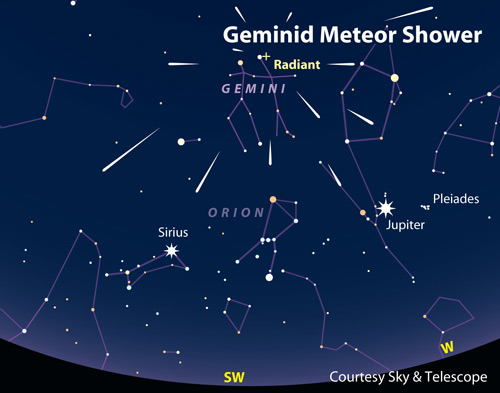
Picture courtesy: Sky & Telescope
How are the showers named?
As we know each area in sky is divided into constellations (such as Orion, Gemini, Leo), the constellation in which the radiant lies is how meteors are named. The radiant of the meteor shower that peaks in December lies in the constellation of Gemini so it is named “Geminids Meteor Shower” because these meteors seems to be radiating from Gemini.
Where to Observe?
Why travel for the Geminids? Because under a true dark sky, everything changes. The Milky Way becomes visible from horizon to horizon, constellations appear sharper, and meteors streak across the sky with greater contrast and color. During the 2025 peak, observers can expect 80–120 meteors per hour, turning the night into a cosmic fireworks display.
A Geminid Meteor caught in the camera of Abubaker Shekhani on 14th Dec 2020
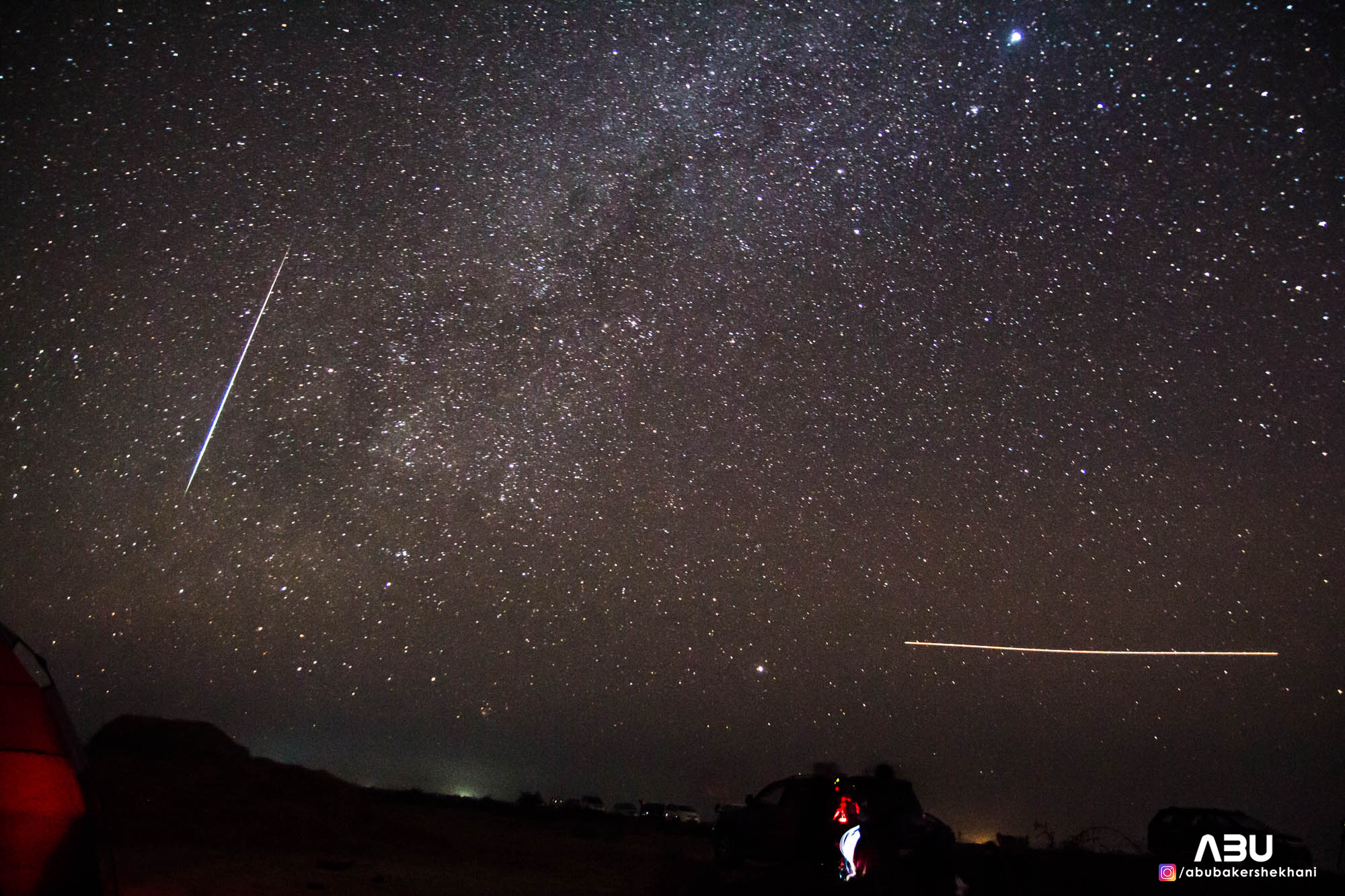
The Geminids originate from 3200 Phaethon, a rare asteroid-like body that creates unusually bright and dense meteors. This unique origin makes the shower one of the most dynamic and reliable of the year.
Whether you join the Karachi-to-Balochistan expedition or observe from your own dark-sky location, Geminids 2025 promises a night filled with wonder a chance to disconnect from the world and reconnect with the universe.
How to watch/observe?
You don’t need a telescope or a binocular to watch the meteor shower. All you need is a dark sky and your naked eyes. Meteor shower comes under Naked-eye Astronomy and this is how we did it. Visit the below post to see how to observe.
How to observe Geminids Meteor Shower or any meteor shower in Pakistan